What Are Digital Hackathons in Campus Placements?
 ··5 min read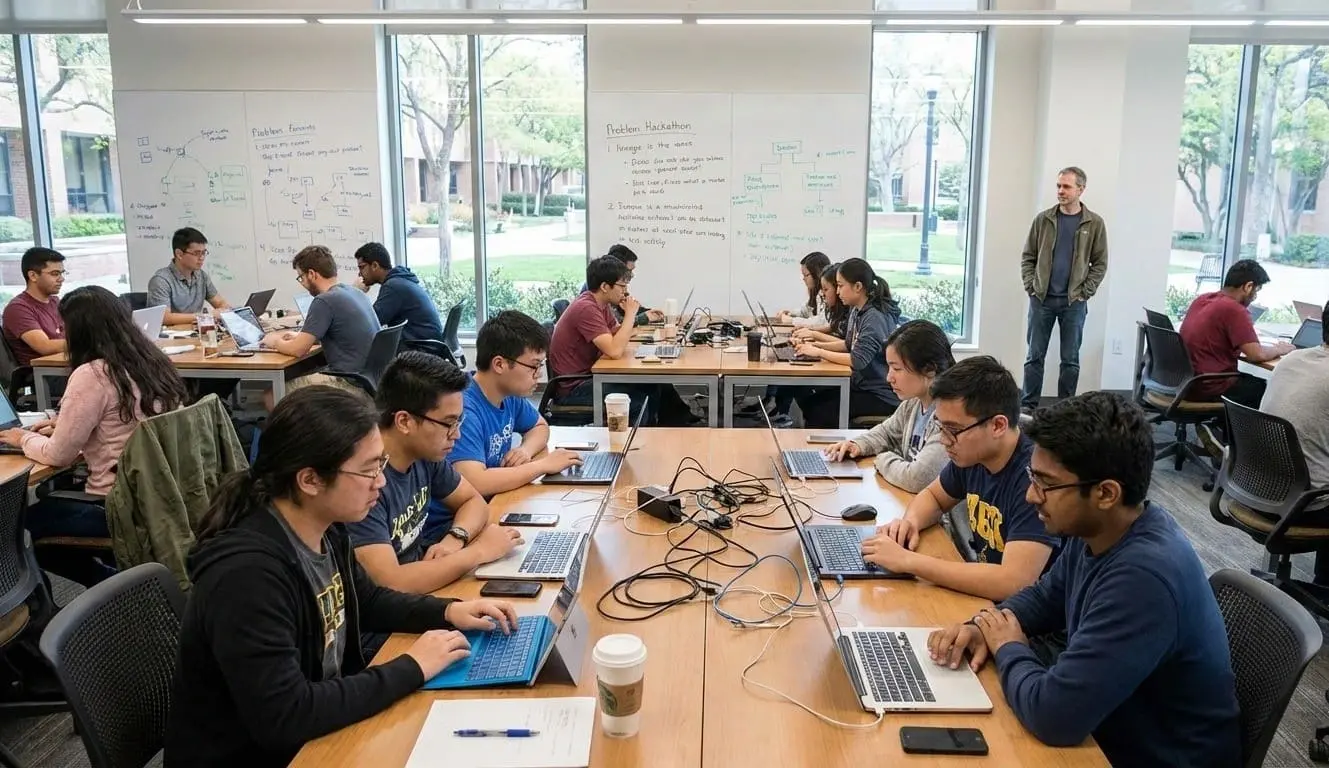
Digital hackathons in campus placements are structured online challenges where students solve realistic software problems in teams, replacing theoretical MCQs with experiential assessments. They evaluate code quality, collaboration, and workflow discipline, giving colleges and recruiters direct visibility into job readiness before a single interview takes place.
TL;DR: Digital hackathons in campus placements are structured, time-bound online challenges where students solve realistic software problems in teams, replacing theoretical MCQs with experiential assessments that evaluate code quality, collaboration, and workflow discipline. They give colleges and recruiters direct visibility into job readiness before a single interview takes place.
What Is a Digital Hackathon in Campus Placements?
A digital hackathon in campus placements is a structured online assessment where students work on realistic project tasks within a fixed timeframe, simulating professional development environments as part of the campus recruitment process. Unlike traditional placement tests that focus on theoretical recall, digital hackathons evaluate how students actually build, collaborate, and iterate under real working conditions.
During a campus digital hackathon, students typically:
- Receive structured task assignments similar to Jira-style tickets
- Submit code through Git-based workflows with pull requests
- Collaborate with teammates on shared project deliverables
- Go through AI-driven and manual code reviews on their submissions
Instead of a series of disconnected tests, campus placements become a unified, observable evaluation of practical ability.
Why Digital Hackathons Matter for Campus Placements
Campus placements have traditionally relied on a narrow set of signals: academic grades, MCQ scores, and short interview impressions. These methods fail to answer the question that matters most to recruiters: can this student actually perform in a real project environment?
Digital hackathons address this gap by introducing experiential assessment into the placement process.
- Academic grades do not predict job performance: A student scoring well on theory exams may struggle when asked to build a working feature under realistic constraints.
- Recruiters need observable signals: Digital hackathons provide direct visibility into problem-solving approach, code structure, teamwork, and iteration behavior.
- Students need industry exposure: Working with Git workflows, task boards, and code reviews prepares students for the expectations they will face on day one of a professional role.
- Colleges need differentiation: Institutions that adopt modern assessment methods demonstrate stronger industry alignment and improve placement outcomes.
Skills-based hiring models that prioritize demonstrated ability over credentials are becoming more common across organizations.
How Digital Hackathons Work in a Campus Setting
Step 1: Challenge Design
The recruiting company defines project-based tasks that reflect the real responsibilities of the role being hired for. These are not abstract algorithm puzzles - they involve building features, structuring code, and solving problems that mirror actual engineering work.
Step 2: Student Participation
Students work on the challenge over a defined period, typically 2-5 days. They use real development tools - Git, pull requests, task boards - providing evaluators with a continuous stream of observable activity rather than a single final submission.
Step 3: Multi-Dimensional Evaluation
Instead of scoring only the final output, the evaluation examines the entire development process across multiple dimensions:
| Evaluation Dimension | What It Measures |
|---|---|
| Code Intelligence | Code quality, logical consistency, improvement across iterations |
| Project Execution & Engagement | Task completion rate, consistency, active participation |
| Technical Competency | Foundational knowledge, practical application of concepts |
| Professional Behavior & Collaboration | Communication, teamwork, response to feedback |
Step 4: Data-Driven Shortlisting
Placement coordinators and recruiters receive ranked candidate lists with detailed performance insights. This enables faster, more confident shortlisting based on measurable evidence rather than subjective interview impressions.
Traditional Campus Assessments vs Digital Hackathons
| Factor | Traditional Campus Assessments | Digital Hackathons |
|---|---|---|
| Evaluation basis | MCQs, written tests, interviews | Real project work |
| Skill signal | Theoretical recall | Practical and observable execution |
| Collaboration assessment | Not assessed | Directly observed through team tasks |
| Duration | Hours (single sitting) | 2-5 days of continuous activity |
| Industry alignment | Low - exam-style format | High - mirrors real engineering workflows |
| Candidate differentiation | Limited - similar scores cluster | Strong - workflow patterns reveal clear gaps |
| Feedback to students | Pass/fail or score | Detailed performance insights |
Common Mistakes When Running Digital Hackathons on Campus
- Treating it as a competition, not an evaluation. Campus hackathons for placements should focus on assessment quality, not leaderboard rankings. Overemphasizing "winners" misses methodical candidates who produce high-quality work without rushing.
- Using unrealistic problem statements: Challenges should reflect actual job tasks. Abstract algorithm puzzles fail to predict on-the-job performance and frustrate students who have strong practical skills.
- Evaluating only the final submission: The real value lies in observing the development process: commit patterns, pull request quality, iteration behavior, and collaboration signals. Judging only the end result misses critical hiring signals.
- Not preparing students for the format. Students unfamiliar with Git workflows and team-based development will underperform regardless of their technical ability. Colleges should ensure students have basic exposure to these tools before the hackathon.
- Skipping the collaboration component costs valuable signals. Individual challenges miss teamwork and communication skills. Team-based digital hackathons reveal how students work with others under real project constraints.
FAQ
What is a digital hackathon in campus placements? It is a structured online challenge where students solve realistic software problems in teams as part of the placement process. Evaluation is based on code quality, collaboration, and workflow behavior.
How long does a campus placement hackathon last? Most run 2 to 5 days. That gives students enough time to show how they work, solve problems, and improve their solutions.
Do digital hackathons replace traditional campus placement tests? Not entirely. They add an experiential layer to the process. The best results come from combining hackathons with aptitude screening and final interviews.
What skills do campus digital hackathons evaluate? Code quality, problem-solving, Git workflow discipline, teamwork, communication, how candidates respond to feedback, and their ability to deliver consistent work over several days.
How do colleges benefit from using digital hackathons in placements? Colleges gain stronger industry alignment, better placement outcomes, and a way to demonstrate student readiness beyond academic scores. Students also get hands-on exposure to professional development workflows.
Conclusion
Campus placements are evolving beyond MCQs and interview panels. Digital hackathons introduce an experiential assessment layer that evaluates what matters most to recruiters: whether a student can actually perform in a real project environment.
When implemented thoughtfully, digital hackathons help colleges prepare students for industry expectations, give recruiters reliable performance signals, and create a fairer, more comprehensive placement process that benefits everyone involved.
Related Articles


Ready to transform your tech hiring?
Start evaluating candidates based on real-world capabilities, not just resumes.