How Candidates Can Prepare for a Digital Hackathon Assessment
 ··4 min read
Candidates should prepare for digital hackathons by focusing on real-world engineering practices rather than competitive programming. Success involves active team communication, maintaining structured Git commit histories, prioritizing readable code, and demonstrating adaptability when responding to technical feedback.
TL;DR: Preparing for a digital hackathon requires focusing on real-world engineering practices rather than competitive programming puzzles. Candidates succeed by prioritizing clean Git workflows, clear team communication, readable code, and adaptability to feedback during the experiential assessment.
What Is a Digital Hackathon Assessment?
A digital hackathon assessment is a structured, project-based evaluation where candidates solve realistic software challenges, often in a team environment, to demonstrate their practical job readiness. Unlike an exam where you memorize answers, this assessment mirrors a real professional workflow, focusing on how you build rather than just whether your code compiles.
During the assessment, hiring teams evaluate your entire process-from how you break down a Jira-style ticket to how you submit pull requests and iterate based on code reviews.
Why Preparation Matters for Experiential Assessments
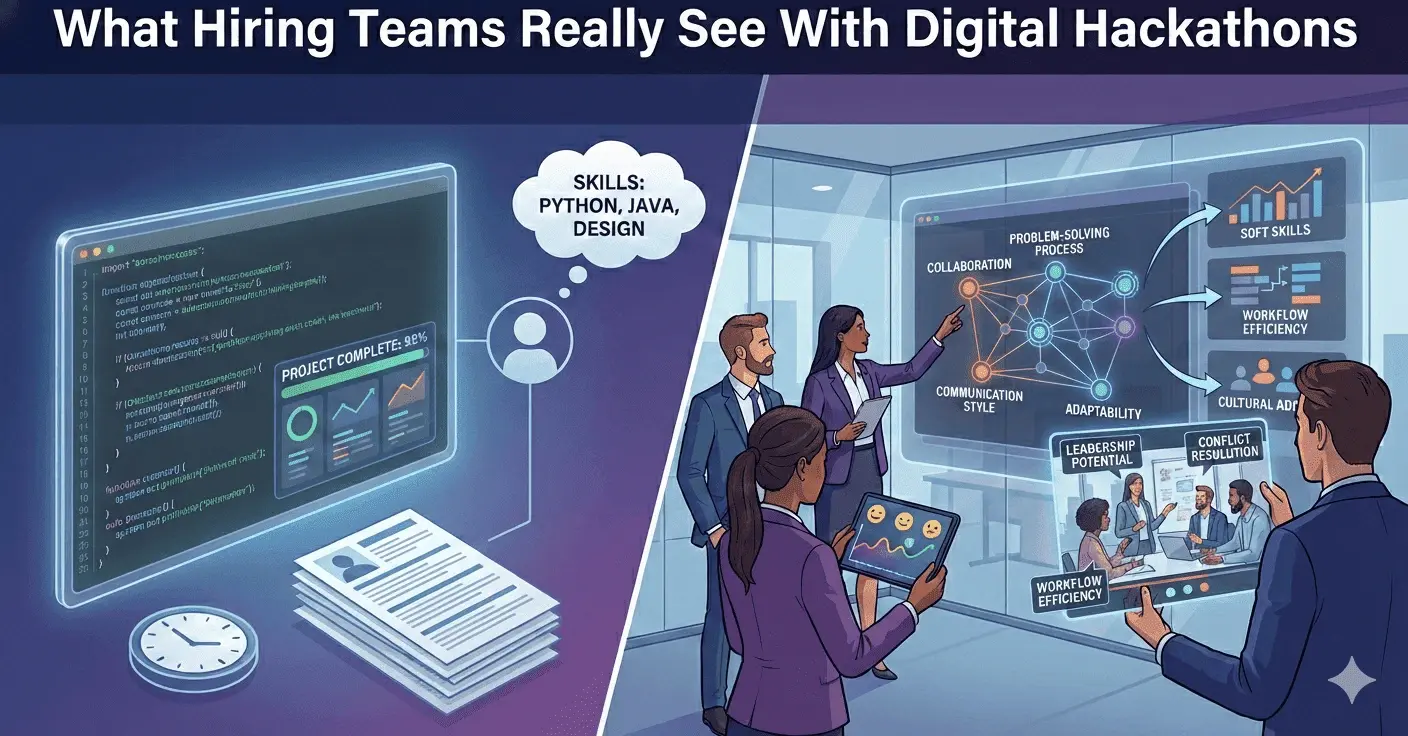
Most candidates are accustomed to traditional coding tests where speed and algorithmic knowledge are the only metrics that matter. A digital hackathon is different. Hiring teams are looking at:
- The process is the product: Your commit patterns and problem-solving approach matter more than the final output.
- Collaboration is measured: Communicating with teammates and working within constraints is as important as technical skills.
- Adaptability is tested: Real projects involve changing requirements and constructive feedback. How you respond to these changes is a critical evaluation dimension.
Candidates who prepare for a digital hackathon the same way they prepare for a standard coding interview often struggle. It is not that they lack technical skills. The problem is failing to demonstrate professional behavior and workflow discipline.
How the Evaluation Works
Stage 1: Understanding the Requirements
You are given a realistic project prompt and expected to clarify assumptions before writing code. This phase tests your ability to translate business needs into technical tasks.
Stage 2: Incremental Development
Instead of rushing to a final solution, you must build features iteratively. Evaluators look for logical consistency and steady progress over the 2-5 day timeframe.
Stage 3: Code Review and Iteration
Your submissions are evaluated through AI-driven and manual code reviews. How you handle feedback and refine your implementation provides a strong signal of your learning potential.
Practical Steps to Succeed
- Treat it like a real job: Write clear documentation, use descriptive variable names, and structure your architecture for maintainability.
- Communicate actively: Provide updates on your progress, document your blockers, and ask questions when requirements are ambiguous.
- Commit frequently and clearly: Use small, meaningful commits with descriptive messages rather than a single massive upload at the end.
- Embrace feedback: If a reviewer points out a flaw or suggests an optimization, implement it promptly and professionally.
Common Mistakes Candidates Make
- Optimizing for cleverness over clarity. Writing overly complex code to show off will hurt your score. Prioritize readability and structure.
- Ignoring team members. In team-based assessments, failing to collaborate or monopolizing tasks reflects poorly on your professional behavior.
- Neglecting Git hygiene. Unclear commit messages or dumping all code in one final push hides your problem-solving process from the evaluators.
- Panicking over incomplete features. Hiring teams prefer three well-built, robust features over five buggy, hastily finished ones.
- Failing to ask questions. Making incorrect assumptions instead of clarifying requirements demonstrates a lack of communication skills.
Traditional Coding Test vs Digital Hackathon Preparation
| Focus Area | Traditional Coding Test | Digital Hackathon Assessment |
|---|---|---|
| Primary goal | Find the optimal algorithm fast | Build a functional, maintainable feature |
| Key skill | Theoretical knowledge | Practical application |
| Code style | Often ignored if it passes tests | Critical for code intelligence scores |
| Communication | Mostly silent execution | Active collaboration required |
| Handling errors | Fail state | Opportunity to debug and iterate |
FAQ
What is a digital hackathon assessment? It is a hands-on evaluation where you work on realistic software projects instead of answering abstract coding puzzles. Think of it as a paid trial project where hiring teams watch how you actually build things.
How much time should I spend on a digital hackathon? Challenges usually run 2 to 5 days. Treat it like a standard work week, not a coding marathon. Consistent, focused hours beat all-nighters every time.
Should I prioritize speed or code quality? Code quality, without question. Evaluators want to see clean, structured, maintainable code - not a rushed mess that barely compiles.
Do I need to finish every requirement to pass? No. Hiring teams would rather see three well-tested, production-quality features than five half-broken ones.
What tools should I prepare before starting? Get comfortable with Git workflows, pull request best practices, and whatever frameworks the role requires. You will be using standard industry tools throughout.
Conclusion
A digital hackathon assessment is your opportunity to show an employer exactly what it would be like to work with you on a daily basis. Focus on clear communication, disciplined workflows, and readable code. You will stand out.
Remember, hiring teams are looking for reliable colleagues, not just fast typists. Treat the assessment as your first week on the job, and your professional execution will speak for itself.
Related Articles
Ready to transform your tech hiring?
Start evaluating candidates based on real-world capabilities, not just resumes.