What Hiring Teams Really See With Digital Hackathons
 ··4 min read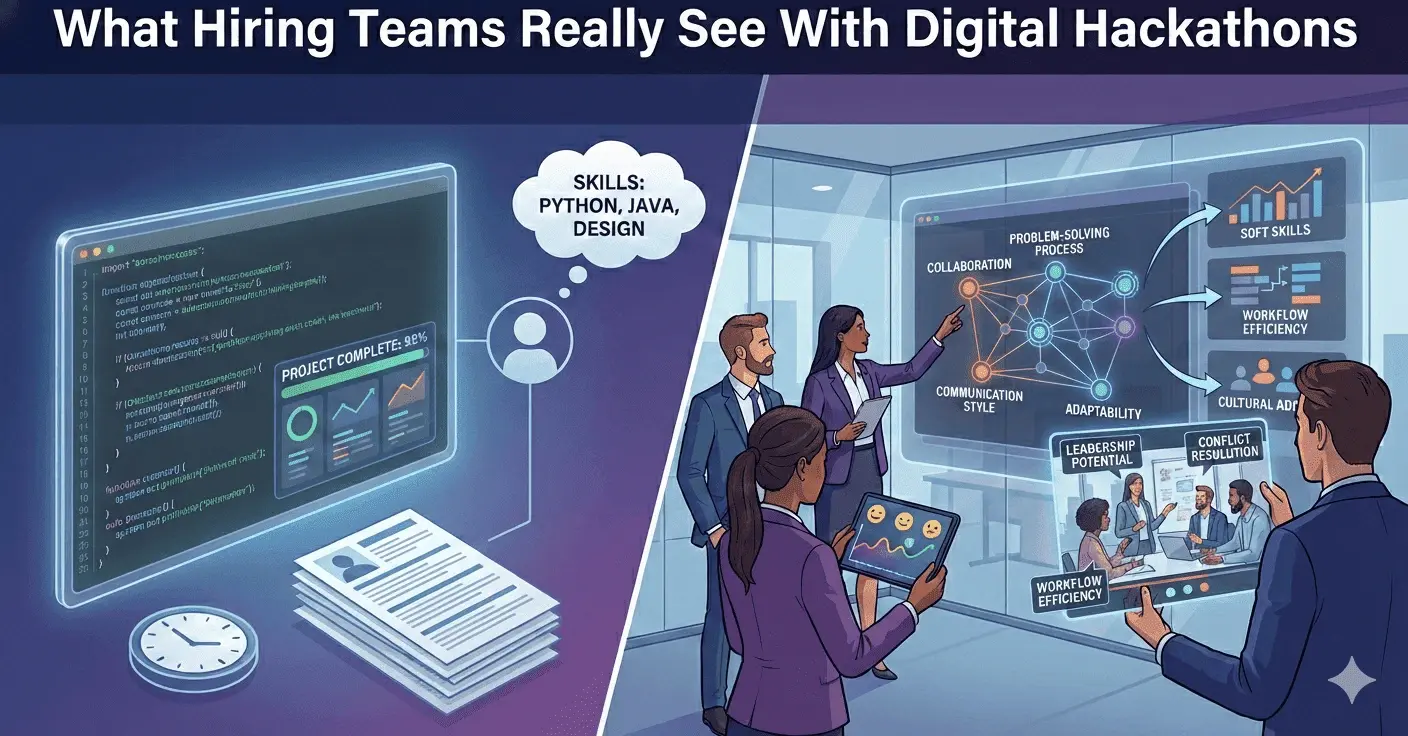
Digital hackathons allow hiring teams to directly observe a candidate's practical capabilities, including their problem-solving methodology, teamwork, and response to constraints. This approach replaces fragmented resume data with high-fidelity performance signals, leading to faster, more confident hiring decisions and a reduced risk of technical mis-hires.
TL;DR: Digital hackathons give hiring teams direct visibility into how candidates actually work-their problem-solving approach, code quality, collaboration style, and response to feedback. This replaces fragmented resume signals with observable, measurable performance data that leads to faster and more confident hiring decisions.
What Do Hiring Teams See in a Digital Hackathon?
A digital hackathon for hiring is a structured evaluation where candidates work on realistic project tasks, giving hiring teams direct observation of skills that resumes and interviews cannot reliably reveal. Instead of relying on self-reported experience, hiring managers watch candidates build, collaborate, and iterate in real time.
Traditional hiring asks candidates to describe their abilities, while digital hackathons require them to demonstrate those abilities under real working conditions.
Why Visibility Into Real Work Matters
Hiring decisions are often based on incomplete information. Resumes show credentials, not capability. Interviews reveal communication skills, not engineering discipline. Coding tests measure algorithm knowledge, not practical execution.
Digital hackathons close these visibility gaps by surfacing signals that matter most for on-the-job success:
- Problem decomposition: how candidates break complex requirements into manageable tasks
- Code architecture: whether they write clean, structured, maintainable code
- Collaboration patterns: how they communicate progress, blockers, and decisions with teammates
- Adaptability: how they respond when requirements change or feedback arrives
These are the signals that tell you whether a new hire will contribute effectively from day one.
How Digital Hackathons Change the Hiring Workflow
From Fragmented Signals to Full Visibility
Traditional hiring collects data points in isolation-a resume here, an interview impression there, a coding test score somewhere else. Digital hackathons consolidate evaluation into a single, comprehensive experience where all signals are captured simultaneously.
From Sequential to Parallel Evaluation
Instead of screening candidates one at a time through multiple rounds, hackathons allow hiring teams to evaluate an entire candidate pool in parallel. This dramatically compresses hiring timelines.
From Subjective to Data-Driven Decisions
Every action a candidate takes during a hackathon is observable and measurable:
| Signal | What Hiring Teams See |
|---|---|
| Commit history | How candidates build solutions incrementally |
| Pull request quality | Code organization, documentation, and review readiness |
| Task completion | Ability to deliver against requirements and deadlines |
| Team communication | Proactive updates, question-asking, and blocker resolution |
| Iteration behavior | Willingness to refine and improve work based on feedback |
From Guessing to Confidence
With this level of visibility, hiring decisions shift from "we think this person might work out" to "we have evidence that this person can deliver."
What Hiring Teams Gain vs Traditional Methods
| Capability | Traditional Hiring | Digital Hackathon Hiring |
|---|---|---|
| See real code quality | No - only test output | Yes - full commit and PR history |
| Observe collaboration | No - individual interviews | Yes - team-based tasks |
| Assess adaptability | No - controlled Q&A | Yes - changing requirements |
| Evaluate multiple candidates | Sequential, slow | Parallel, fast |
| Reduce internal disagreement | High - subjective opinions | Low - shared performance data |
| Candidate experience | Stressful, exam-like | Engaging, work-like |
Common Mistakes Hiring Teams Make
- Treating hackathons as competitions. The goal is evaluation, not ranking. Overemphasizing "winners" misses candidates who work methodically and produce high-quality output without rushing.
- Relying only on final submissions: The most valuable insight comes from the process - how candidates structured their work, responded to feedback, and iterated over time.
- Not involving engineering stakeholders: Recruiters alone cannot fully assess technical hackathon output. Engineering managers should review code quality and workflow signals directly.
- Failing to communicate evaluation criteria hurts outcomes. Candidates perform better when they understand what is being assessed. Transparency improves both the candidate experience and the quality of signals collected.
FAQ
What do hiring teams look for in a digital hackathon? They look at how candidates approach problems, write code, collaborate, communicate, iterate based on feedback, and handle changing requirements. These signals predict on-the-job performance.
How do digital hackathons reduce mis-hires? By watching candidates do actual work instead of relying on resumes, hackathons reveal skill gaps, overstated experience, and role mismatches before an offer is made.
Can digital hackathons replace interviews entirely? Not entirely. Hackathons give you strong technical signals, but interviews still help assess culture fit and long-term alignment. The best results come from combining both.
Do digital hackathons create a more inclusive hiring pipeline? Yes - when evaluation is based on demonstrated skills rather than credentials, candidates from non-traditional backgrounds get a fair shot. Self-taught developers, bootcamp graduates, and career switchers all benefit.
How do hiring teams share hackathon results internally? Hackathons generate concrete data - code reviews, task completion rates, collaboration metrics - that recruiters, hiring managers, and interviewers can all review together. This reduces subjective disagreements about candidates.
Conclusion
Digital hackathons do not just improve hiring processes-they make hiring more honest. They shift the focus from how well someone presents themselves to how effectively they can work in real-world conditions.
Hiring teams that prioritize observable performance over proxies will make faster, more confident decisions and build stronger, more reliable engineering teams.
Related Articles
Ready to transform your tech hiring?
Start evaluating candidates based on real-world capabilities, not just resumes.