How Digital Hackathons Help Companies in Campus Hiring
 ··5 min read
Digital hackathons help companies in campus hiring by replacing resume-based screening with real-world project evaluation. They enable parallel assessment of large candidate pools, reduce early-career mis-hire risk through observable performance data, and improve alignment between campus hires and actual job requirements.
TL;DR: Digital hackathons help companies in campus hiring by replacing resume-based screening with practical evaluation. They enable parallel assessment of large candidate pools, reduce early-career hiring risk through observable performance data, and improve alignment between campus hires and actual job requirements.
What Is a Digital Hackathon for Campus Hiring?
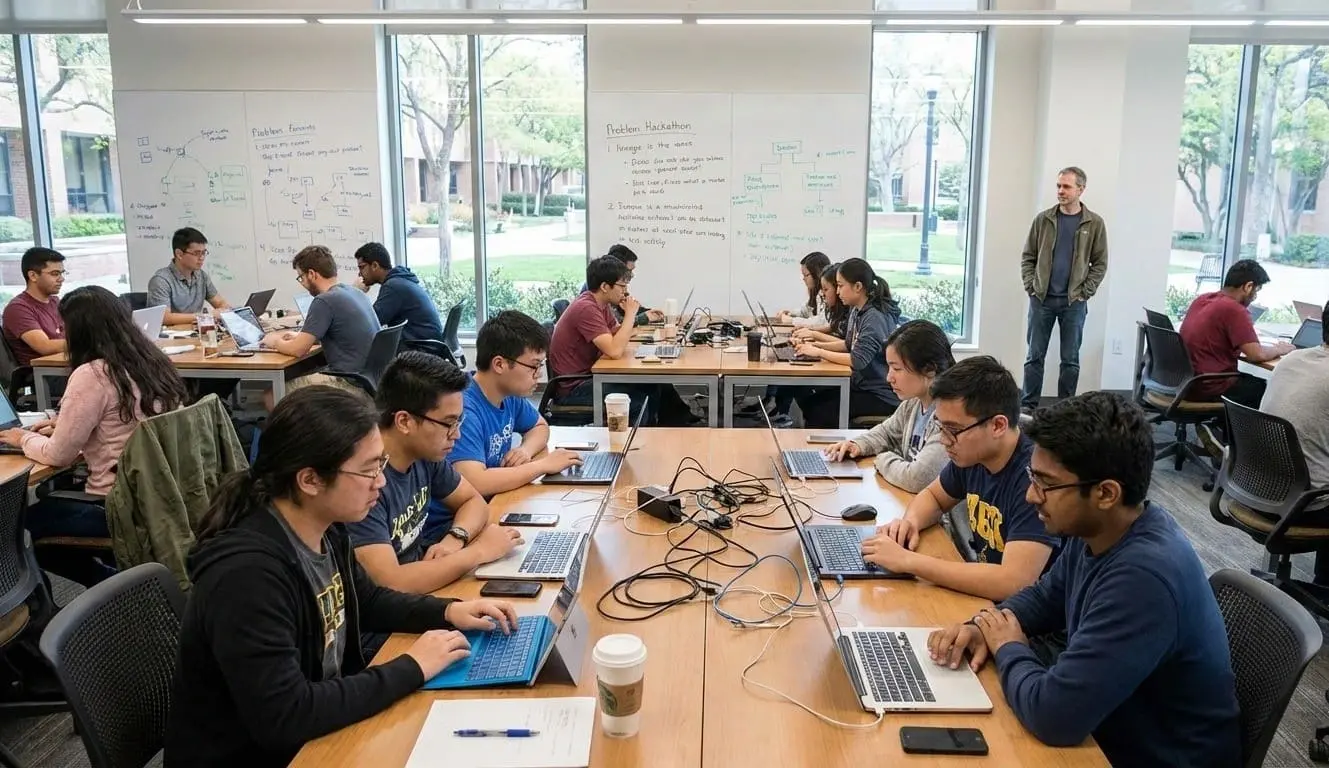
A digital hackathon for campus hiring is a structured, time-bound online evaluation where companies assess student candidates through realistic project work instead of traditional tests and interviews. Candidates work on tasks that mirror actual job responsibilities, giving hiring teams direct visibility into practical ability, collaboration, and development workflow discipline.
Unlike standard campus recruitment methods that rely on MCQs, short interviews, and academic transcripts, digital hackathons generate multi-dimensional performance data. Companies can observe how candidates approach problems, structure code, work in teams, and respond to feedback - all within a single assessment experience.
Why Companies Need Better Campus Hiring Methods
Campus hiring lets companies build early talent pipelines, but it comes with significant challenges. Hiring teams have a limited campus window, screen hundreds of students, and must make decisions with minimal data. The result is a high rate of early-career mis-hires.
The core problems:
- Resume overload: Hundreds of similar academic profiles make differentiation nearly impossible.
- Theoretical-only evaluation: MCQs and coding tests reveal knowledge, not practical ability.
- No collaboration signal: Individual assessments miss teamwork and communication.
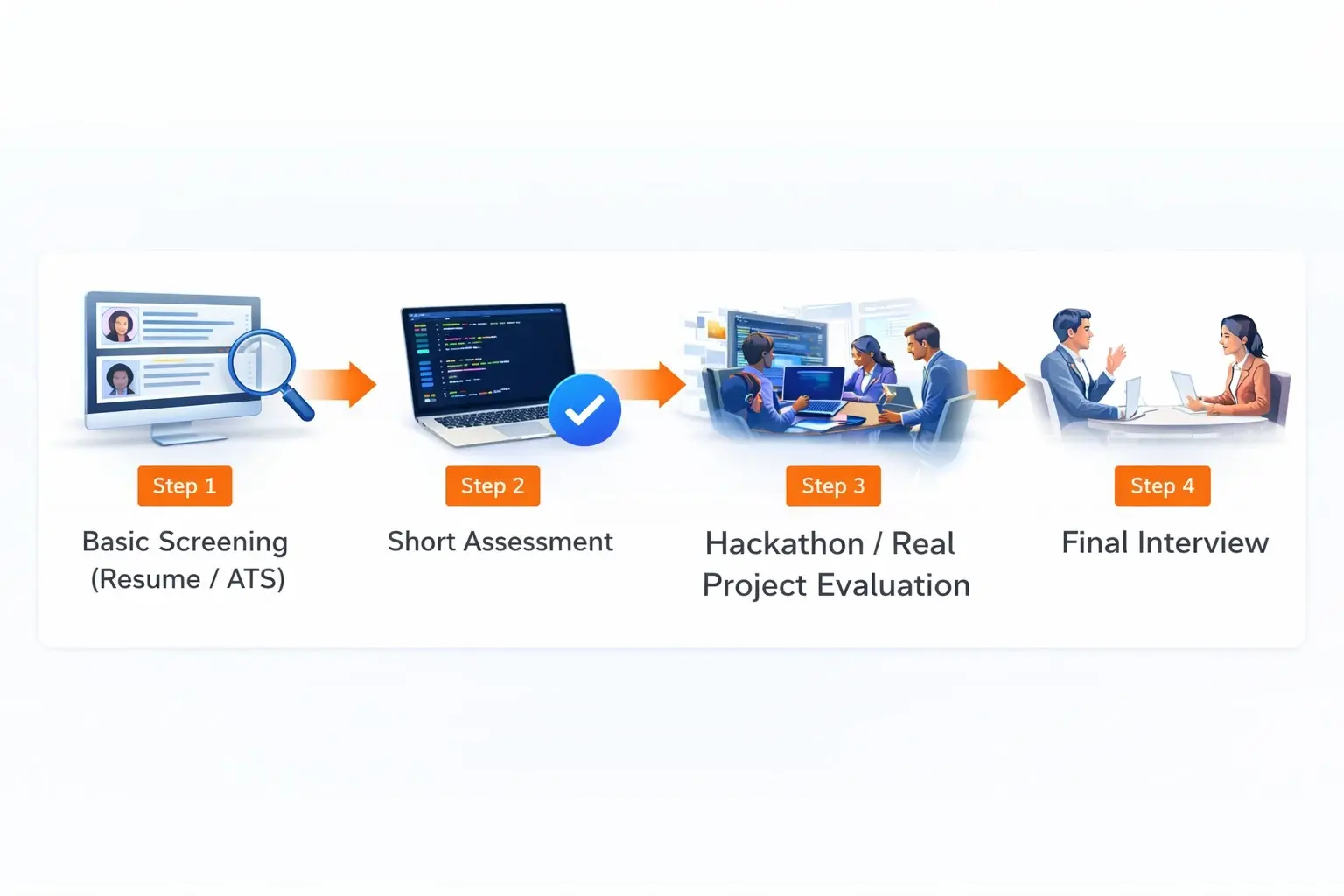
- Slow multi-round processes: Sequential screening and interviews extend timelines and increase drop-off.
- High mis-hire risk: Limited signals lead to hires who underperform on the job.
Digital hackathons address these problems by replacing proxy-based evaluation with direct observation of candidate performance.
How Digital Hackathons Improve the Campus Hiring Process
Better Visibility Into Candidate Capabilities
Digital hackathons provide hiring teams with a complete picture of how each candidate works:
- Problem-solving approach: How candidates break down requirements and plan their implementation
- Code structure and quality: Whether they write clean, maintainable, well-organized code
- Collaboration behavior: How they communicate with teammates, share progress, and resolve blockers
- Adaptability: How they respond to changing requirements, feedback, and review comments
This level of visibility is impossible to achieve through resumes or 30-minute interviews.
Faster and More Confident Shortlisting
Campus hiring often involves screening hundreds of students within a few days. Digital hackathons transform this process:
- Parallel evaluation: All candidates are assessed simultaneously rather than sequentially
- Automatic self-selection: Only serious, motivated candidates complete the full challenge
- Data-driven ranking: Performance data replaces subjective impressions, enabling faster shortlisting
- Fewer interview rounds: Strong hackathon data reduces the need for multiple follow-up evaluations
Companies running digital hackathons report shorter hiring cycles and greater confidence in their campus decisions.
Reduced Risk in Early-Career Hiring
Early-career hiring carries inherent risk because candidates have limited professional track records. Digital hackathons reduce this risk by generating the evidence that resumes cannot provide:
| Risk Factor | Traditional Approach | Digital Hackathon Approach |
|---|---|---|
| Skill verification | Based on grades and self-reported skills | Based on observed project execution |
| Job readiness signal | Inferred from academic performance | Directly measured through real tasks |
| Collaboration ability | Assumed or not assessed | Observed through team-based work |
| Learning potential | Guessed from interview responses | Visible through iteration and improvement behavior |
| Mis-hire identification | Discovered after onboarding | Identified before the offer is made |
Stronger Alignment With Real Project Needs
Digital hackathons are designed around tasks that reflect actual job responsibilities. This means companies assess candidates on skills that directly matter for the role:
- Job readiness: Can the candidate perform the work they will be hired to do?
- Technical foundations: Do they have the core skills required for the team's technology stack?
- Learning ability: Can they improve their work through iteration and feedback?
- Team fit: Do they collaborate effectively and communicate clearly?
This alignment reduces the gap between what a campus hire demonstrated during assessment and what they deliver once they join the team.
Improved Candidate Experience and Employer Brand
From a company perspective, digital hackathons also strengthen the employer brand on campus:
- Meaningful engagement: Students work on realistic challenges instead of sitting through exam-style tests
- Closer to real work: The experience mirrors professional environments, building student confidence
- Role clarity: Candidates gain firsthand understanding of what the job actually involves
- Fair evaluation: Students from diverse backgrounds compete on demonstrated ability, not pedigree
Companies that provide a strong assessment experience are more likely to attract top talent in subsequent campus cycles.
Traditional Campus Hiring vs Digital Hackathon Hiring
| Factor | Traditional Campus Hiring | Digital Hackathon Hiring |
|---|---|---|
| Evaluation basis | Resumes, MCQs, interviews | Real project execution |
| Candidate throughput | Sequential, slow | Parallel, scalable |
| Skill signal | Theoretical recall | Practical and observable |
| Collaboration assessment | Not assessed | Directly observed |
| Time to shortlist | Multiple rounds over days | Single challenge, consolidated data |
| Hiring confidence | Based on limited signals | Based on multi-dimensional performance |
| Early-career risk | High - minimal evidence | Reduced - observable track record |
| Candidate experience | Exam-like, impersonal | Engaging, work-like |
Common Mistakes Companies Make in Campus Hiring
- Relying solely on academic performance. Grades indicate theoretical knowledge but not practical ability. Companies that filter only by GPA miss strong candidates who excel in execution.
- Running generic coding tests: Short, algorithm-focused tests do not predict how a candidate will perform in a real project environment. Context-rich challenges yield far better signals.
- Skipping team-based evaluation: Individual assessments miss critical collaboration and communication skills. Most engineering roles require working effectively within a team.
- Not investing in candidate experience: A poorly structured campus process damages employer brand and reduces acceptance rates. Clear instructions, fair timelines, and constructive feedback matter.
- Making decisions on single data points is risky. A strong interview or test score does not guarantee long-term success. Multi-dimensional evaluation provides a more reliable picture.
FAQ
How do digital hackathons help companies in campus hiring? They let you evaluate large candidate pools through real project work instead of resumes. You get observable data on code quality, collaboration, and workflow discipline.
Can digital hackathons work for hiring interns? Absolutely. Interns often lack extensive work history, which makes hackathons a strong fit. They reveal practical ability and learning potential that transcripts cannot show.
How many candidates can a company evaluate in one campus hackathon? Dozens to hundreds at the same time. The parallel format removes the bottleneck of sequential interviews while keeping evaluation depth.
Do candidates prefer hackathons over traditional campus tests? Generally, yes. Most candidates find project-based tasks more engaging than MCQ tests. The experience mirrors real engineering work and gives them clearer expectations.
What metrics do companies track during a campus hiring hackathon? Commit frequency, pull request quality, task completion rates, code structure, iteration behavior, team collaboration signals, and how candidates respond to feedback.
Conclusion
Campus hiring does not have to be a gamble. Digital hackathons give companies the tools to evaluate early-career candidates on what actually matters - their ability to build, collaborate, and deliver in real project conditions.
By replacing resume-based screening with performance-based evaluation, companies reduce mis-hire risk, shorten hiring timelines, and build stronger entry-level teams. Organizations that adopt this approach first will have an advantage over those still relying on grades and short interviews to identify talent.
Related Articles

Ready to transform your tech hiring?
Start evaluating candidates based on real-world capabilities, not just resumes.