Hackathon-Based Hiring + ATS Integration: A Game Changer for Technical Recruitment
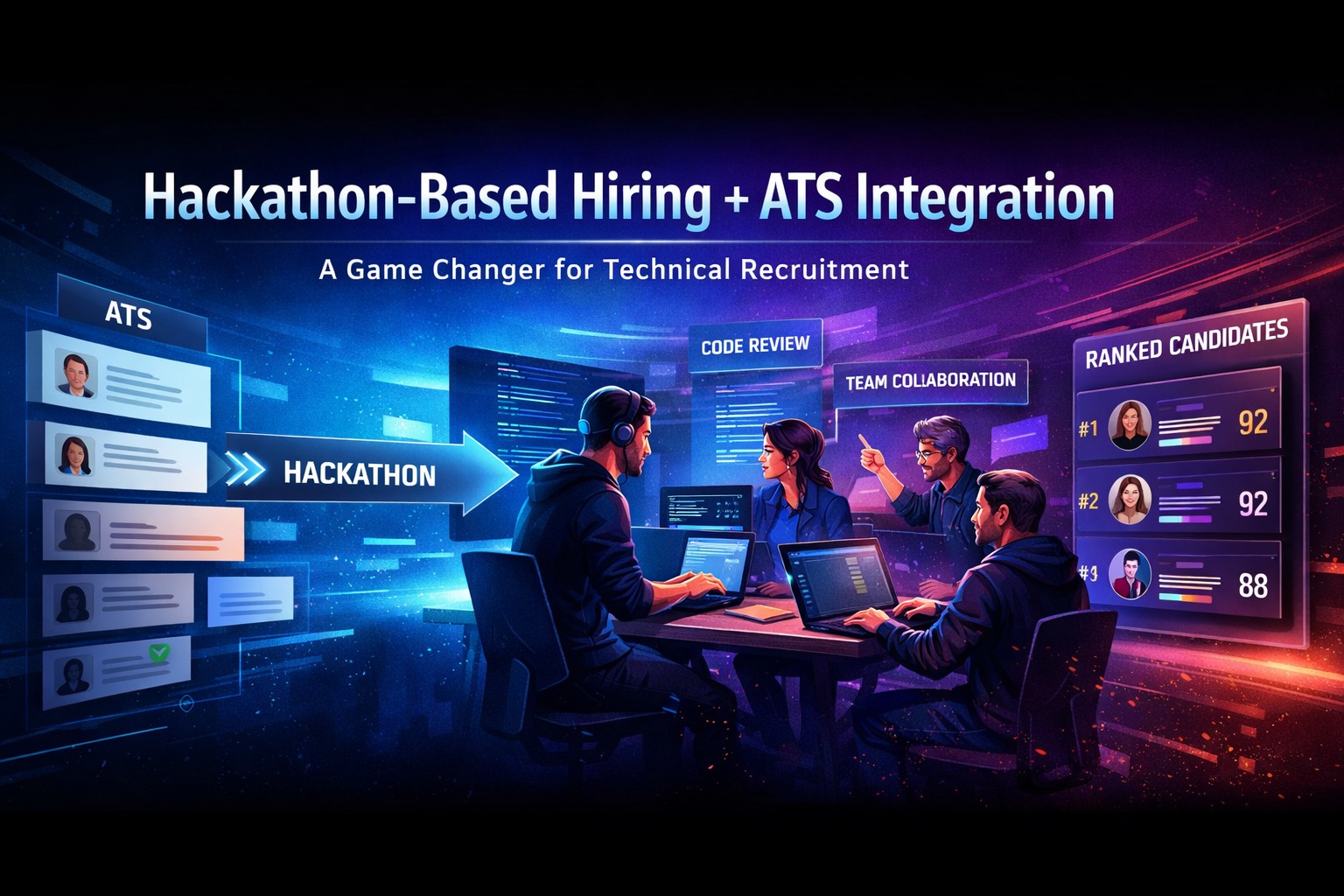

TL;DR: Integrating digital hackathons directly into your Applicant Tracking System (ATS) automates technical screening and moves evaluation from resume-guessing to performance-proving. This synergy allows recruiters to evaluate large candidate pools simultaneously, reducing hiring time by up to 90% while maintaining an exceptionally high technical bar.
What Is ATS Integration in Technical Recruitment?
ATS integration in the context of experiential assessments is the seamless data connection between your recruitment pipeline software (like Lever, Greenhouse, or Workday) and a technical evaluation platform (like TeamCraft). This integration automates challenge assignments and synchronizes candidate performance scores back to the recruiter's primary dashboard.
Historically, the gap between candidate tracking and candidate evaluation has been a massive source of friction. Recruiters manage applications in an ATS, but engineering teams conduct and manually score take-home projects or live coding tests in disparate systems, leading to delayed feedback loops and lost talent.
Why Manual Technical Screening is Failing
Technical hiring today is notoriously slow and expensive. On average, filling a technical role takes 30–45 days. This inefficiency stems directly from a reliance on manual resume screening and fragmented evaluation tools. Integrating digital hackathons with an ATS solves this because:
- Resumes are poor indicators of skill — Automating an experiential assessment immediately proves candidate capability, bypassing the need to guess based on a CV.
- Manual grading is unscalable — Having senior engineers manually review hundreds of Git repositories is impossible; integrated AI-driven scoring solves this bottleneck.
- Speed wins talent — Top engineers do not wait around for a recruiter to manually email them a next-steps link three weeks after they apply.
How Hackathon-ATS Integration Works
Automated Assignment on Application
As soon as a candidate applies for a specific role and enters the "Assessment" stage in the ATS, a webhook automatically triggers the evaluation platform to send the candidate a personalized digital hackathon invitation.
Real-World Evaluation Phase
Candidates log into the platform, join teams or work individually, and complete real-world project requirements using standard engineering tools (Git, IDEs, issue trackers).
AI-Assisted Scoring and Sync
Once the assessment period concludes, the platform's AI reviews the pull requests, code quality, and workflow metrics. These comprehensive scores and a link to the detailed scorecard are automatically pushed back into the candidate's ATS profile.
Practical Steps to Implement ATS Integration
- Map your hiring stages — Define exactly which ATS stage should trigger the digital hackathon invite.
- Configure standardized scoring — Ensure the evaluation platform returns a simple, standardized metric (e.g., 0-100 scale or Pass/Fail) to the ATS for easy filtering.
- Set automated rejection rules — Use ATS automation to instantly reject candidates who fail to meet the minimum experiential assessment score.
- Communicate the workflow — Clearly inform candidates in the automated invite email about what to expect, the timeline, and the tools they will use.
Common Mistakes When Integrating Assessments
- Triggering assessments too late — Waiting until after an HR screen to send an assessment wastes recruiter time. Push the hackathon earlier in the funnel to filter automatically.
- Not syncing detailed data — Passing only a "Pass/Fail" flag back to the ATS deprives the hiring manager of context. Ensure the detailed technical scorecard is linked.
- Over-complicating the trigger conditions — Creating brittle, complex automation rules in the ATS leads to candidates falling through the cracks. Keep triggers simple and state-based.
- Ignoring candidate drop-off rates — If 90% of candidates do not start the automated assessment, the project may be too long or poorly explained.
- Failing to train recruiters — Recruiters must understand how to read the synced evaluation scores to confidently move candidates forward without waiting for an engineering manager's approval.
Traditional ATS Flow vs Integrated Hackathon Flow
| Process Step | Traditional ATS Flow | Integrated Hackathon Flow |
|---|---|---|
| Screening | Manual resume review by recruiter | Automated skill validation |
| Assessment Trigger | Manual email after HR screen | Automated trigger upon application |
| Evaluation Method | Disconnected whiteboard interview | Hands-on, real-world project |
| Scoring | Subjective feedback in notes | AI-driven metrics synced directly to ATS |
| Time to Shortlist | Weeks | Days |
FAQ
What is ATS integration for digital hackathons? It is the automated connection between a company's applicant tracking system and an experiential assessment platform, ensuring seamless triggering of tests and syncing of scores.
Does ATS integration replace recruiters? No. It empowers recruiters by automating the technical filtering process, allowing them to spend their time building relationships with verified, high-quality talent.
Which ATS platforms support hackathon integrations? Most modern experiential assessment platforms integrate with major ATS providers like Greenhouse, Lever, Workday, and standard webhook-capable systems.
How does the data sync back to the ATS? Once a candidate completes the hackathon, the platform pushes a summary score and a link to the detailed technical scorecard directly into the candidate's ATS profile notes or custom fields.
Will automated assessments discourage candidates? While some candidates drop off, those who remain are highly motivated and confident in their skills. This "self-selection" acts as a powerful natural filter for high-quality engineering talent.
Conclusion
The integration of digital hackathons into Applicant Tracking Systems is a paradigm shift in technical recruitment. By moving from manual resume screening to automated, performance-driven evaluation, companies can drastically reduce their time-to-hire, lower recruitment costs, and confidently scale their engineering teams.
Don’t just track candidates—understand their capabilities instantly by embedding real-world evaluation directly into your hiring pipeline.
Ready to transform your tech hiring?
Start evaluating candidates based on real-world capabilities, not just resumes.