How to Reduce Hiring Time in Tech Recruitment by 90% (Proven Strategies)

Introduction
Reducing hiring time in tech recruitment is one of the biggest challenges companies face today.
Hiring skilled developers often takes 30–45 days or more, leading to:
- Lost top candidates
- Increased hiring costs
- Slower product development
In a competitive market, speed is everything.
So how can companies reduce hiring time by up to 90% without compromising on quality?
The answer lies in optimizing the hiring process, filtering candidates early, and using real-world evaluation methods.
Why Hiring Time Is High in Tech Recruitment
Before solving the problem, it’s important to understand why hiring takes so long.
1. High Volume of Irrelevant Applications
Companies receive hundreds of applications, but only a small percentage are actually qualified.
Recruiters spend hours on:
- Resume screening
- Initial filtering
2. Too Many Hiring Stages
Traditional hiring includes:
- Resume screening
- Coding interviews
- Technical interviews
- HR rounds
Each step adds delay.
3. Lack of Real Skill Evaluation
Candidates may perform well in interviews but struggle in real work scenarios.
This leads to:
- Re-hiring cycles
- Delays in decision-making
Traditional Hiring Process vs Optimized Hiring Process
Traditional Hiring Flow:
- Resume screening
- Coding interview
- Technical interview
- Final interview
Optimized Hiring Flow:
- Basic screening (Resume / ATS)
- Short assessment
- Hackathon or real project evaluation
- Final interview
The difference is simple: filter early, evaluate deeply, and decide faster.
How to Reduce Hiring Time by 90%
1. Filter Candidates Early
Instead of interviewing every applicant, introduce:
- Short assessments
- Real-world tasks
This ensures:
- Only relevant candidates move forward
- Less time spent on unqualified applicants
2. Replace Multiple Interviews with One Strong Evaluation
Traditional hiring relies on multiple rounds.
Optimized hiring uses:
- One comprehensive evaluation (hackathon or project)
This reduces:
- Scheduling delays
- Interview fatigue
- Decision confusion
3. Use Hackathon-Based Hiring
Hackathon-based hiring is one of the most effective ways to reduce time to hire.
It helps companies:
- Evaluate real-world skills
- Assess problem-solving ability
- Measure teamwork and communication
Most importantly:
Only serious candidates complete the process.
This creates automatic candidate filtering.
4. Integrate Hiring with ATS Systems
Using ATS (Applicant Tracking System) integration helps:
- Automate candidate flow
- Eliminate manual tracking
- Sync evaluation results instantly
This removes operational bottlenecks.
5. Make Data-Driven Hiring Decisions
Instead of relying on opinions, use:
- Performance data
- Candidate rankings
- Real output
This leads to:
- Faster decisions
- Higher confidence in hiring
Key Benefits of Reducing Hiring Time
Companies that optimize their hiring process experience:
Faster Hiring Cycles
- Up to 90% reduction in screening time
- Faster candidate shortlisting
Lower Hiring Costs
- Reduced dependency on multiple interview rounds
- Lower operational expenses
Better Candidate Quality
- Focus on candidates who can actually perform
- Higher hiring success rate
Improved Candidate Experience
- Engaging evaluation process
- Reduced waiting time
Best Practices to Improve Hiring Efficiency
To reduce hiring time effectively:
- Use structured hiring workflows
- Minimize unnecessary interview rounds
- Introduce real-world assessments early
- Automate repetitive tasks
- Focus on skill-based evaluation
The Future of Tech Recruitment
Tech hiring is evolving rapidly.
Companies are shifting from:
- Resume-based hiring → Skill-based hiring
- Manual processes → Automated workflows
- Multi-step pipelines → Optimized hiring systems
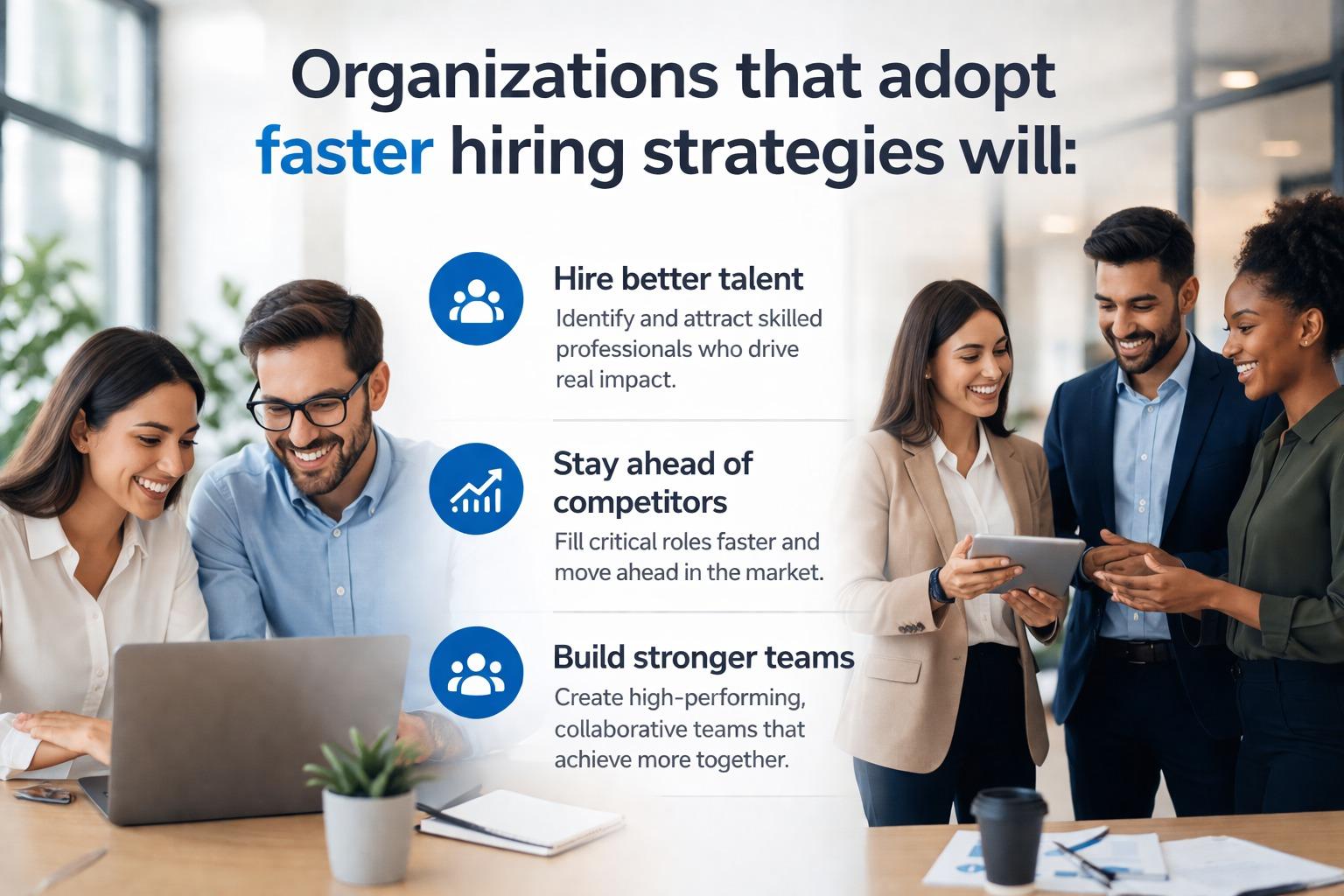
Organizations that adopt faster hiring strategies will:
- Hire better talent
- Stay ahead of competitors
- Build stronger teams
Conclusion
Reducing hiring time is not about speeding up every step.
It’s about eliminating inefficiencies and improving decision-making.
The fastest hiring process is the one that filters early, evaluates effectively, and selects the right candidates quickly.
By using:
- Short assessments
- Hackathon-based hiring
- ATS integration
Companies can reduce hiring time by up to 90% while improving hiring quality.